SOLID Principles Explained: A Visual Guide with Real Examples
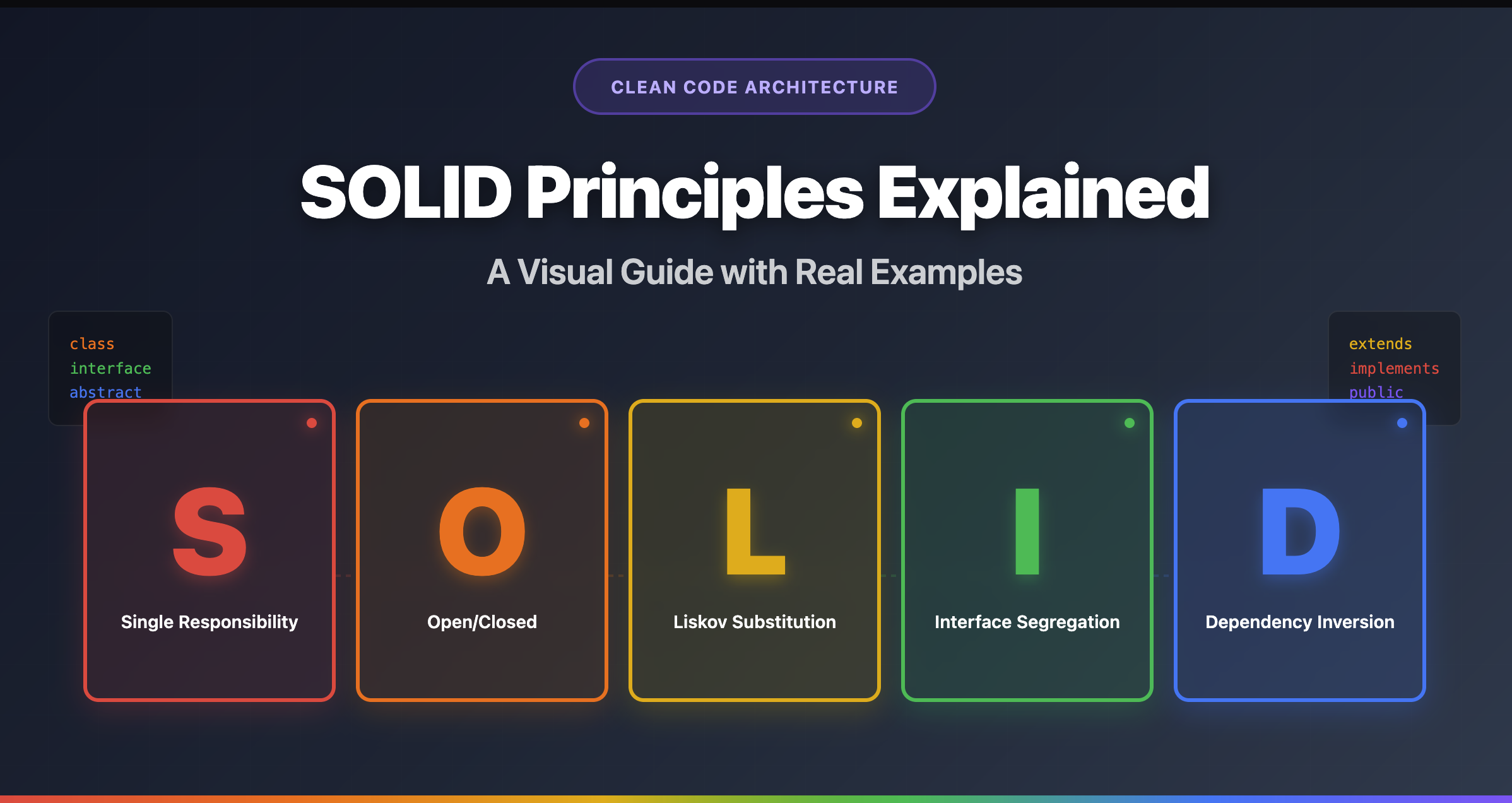
SOLID Principles Explained: A Visual Guide
Every developer has written code they’re ashamed of. A class with 2,000 lines. A function called handleEverything(). A change in one file that mysteriously broke three others.
SOLID principles exist to prevent exactly that. They’re five guidelines—introduced by Robert C. Martin (Uncle Bob)—that tell you how to organize classes and interfaces so your code stays clean, flexible, and maintainable as it grows.
The best part? They’re not abstract theory. They’re practical rules you can apply today. And in LLD interviews, they’re what separates a “good enough” design from an excellent one.
How to Read This Guide
This guide is entirely visual — no code, just diagrams, comparisons, and real-world analogies. Each principle gets a before/after comparison showing what goes wrong when you violate it and what goes right when you follow it.
S — Single Responsibility Principle
The Problem: The God Class
When a single class handles everything—data access, business logic, formatting, logging, email sending—it becomes a “God Class.” Change one thing, and everything breaks.
How It Works in Practice
Here’s how the focused classes interact — each doing one job, collaborating through clear interfaces:
The OrderController orchestrates the flow, but each service handles its own concern. Need to change how emails are sent? Touch EmailService — nothing else.
The Smell Test
Signs You're Following SRP
- You can describe what a class does in one sentence without using “and”
- Changes to one feature only affect one class
- Your class names are specific:
InvoiceGenerator, notUtilities - Unit tests are straightforward with minimal mocking
Signs You're Violating SRP
- A class has more than 200 lines
- You use words like “Manager”, “Handler”, “Processor”, “Utils” as class names
- A change to the database layer requires editing a UI-related class
- Unit tests need complex setup with many dependencies
Deep dive: Single Responsibility Principle
O — Open/Closed Principle
The Problem: The Growing Switch Statement
Every time a new requirement comes in, you modify existing working code. Each modification risks breaking what already works.
How Extension Points Work
The interface acts as the “standard outlet” — existing code depends on the interface, not on specific implementations:
CheckoutService depends on the PaymentMethod interface. When you add Crypto, you only create one new class. CheckoutService doesn’t change. CreditCard doesn’t change. Nothing existing is touched.
Where You’ll See This in Interviews
In almost every LLD interview problem, the interviewer will ask: “What if we need to add a new type of X?” The Open/Closed Principle is how you answer:
- Parking Lot: “Add a new vehicle type” → new class implementing
Vehicleinterface - Rate Limiter: “Add a new algorithm” → new class implementing
RateLimiterinterface - Elevator System: “Add a new dispatch strategy” → new class implementing
DispatchStrategy
Deep dive: Open/Closed Principle
L — Liskov Substitution Principle
The Problem: The Lying Subclass
A class inherits from a parent but doesn’t actually behave like the parent. Code that works with the parent breaks when handed the child.
The Substitution Test
Here’s a visual way to think about it — if code works with the parent type, it must also work with any child type:
If your function calls bird.fly(), then Penguin violates LSP because it can’t fly. The fix: either don’t inherit from Bird, or redesign the hierarchy so fly() isn’t in the base type.
The Simple Rule
Ask yourself: “Can I swap a child object for a parent object everywhere the parent is used, without anything breaking or behaving unexpectedly?” If yes, you’re following LSP. If no, your hierarchy is wrong.
Deep dive: Liskov Substitution Principle
I — Interface Segregation Principle
The Problem: The Fat Interface
One massive interface forces every implementation to deal with methods it doesn’t care about.
The Visual Difference
See how much cleaner the dependencies become when interfaces are segregated:
On the left, every worker depends on 5 methods. On the right, each worker picks only the interfaces it needs.
Real Interview Application
In a Notification Service design, don’t create one fat NotificationSender interface with sendEmail(), sendSMS(), sendPush(), sendSlack(). Instead, create separate interfaces: EmailSender, SMSSender, PushSender. Each channel implements only its own interface.
Deep dive: Interface Segregation Principle
D — Dependency Inversion Principle
The Problem: Direct Dependencies
High-level business logic depends directly on low-level implementation details. Changing the database means rewriting the business logic.
The Dependency Direction
This is the core insight — notice how the arrows flip:
Without DIP: High-level points down to low-level (direct dependency). With DIP: Both high-level and low-level point toward the abstraction (inverted). The abstraction is the “standard outlet” that decouples everything.
Why This Is the Most Important Principle
DIP is the foundation of testable, maintainable software. Without it:
- You can’t write unit tests (you’d need real databases, real APIs)
- You can’t swap implementations (stuck with your initial choices forever)
- You can’t work in parallel (teams are blocked by each other’s infrastructure decisions)
In LLD interviews, using interfaces to define dependencies is the single biggest signal that you’re a strong designer. Every problem — from parking lots to payment processors — benefits from this approach.
Deep dive: Dependency Inversion Principle
How the 5 Principles Work Together
SOLID isn’t five separate ideas — they reinforce each other. Here’s how they connect:
- SRP gives you small, focused classes
- Small classes are easier to extend without modification (OCP)
- Extensions through inheritance must be substitutable (LSP)
- To be substitutable, interfaces must be focused and minimal (ISP)
- Focused interfaces become the abstractions that DIP depends on
- DIP’s clean dependencies make it easy to keep classes single-responsibility
It’s a virtuous cycle. Following one principle naturally leads to following the others.
SOLID in LLD Interviews: A Cheat Sheet
Here’s how to demonstrate SOLID knowledge in your next interview:
| When The Interviewer Says… | Apply This Principle | What To Do |
|---|---|---|
| ”This class does too much” | SRP | Split into focused classes, each with one responsibility |
| ”What if we add a new type?” | OCP | Define an interface; new types implement it without changing existing code |
| ”Can we swap X for Y?” | LSP | Ensure Y behaves correctly everywhere X is used |
| ”This interface is too big” | ISP | Split into smaller interfaces; clients only depend on what they use |
| ”How do you test this?” | DIP | Depend on interfaces; inject mock implementations in tests |
The Interview Signal
You don’t need to name-drop “Liskov Substitution Principle” in an interview. Instead, naturally say things like: “I’ll define an interface here so we can add new types without modifying existing code” (OCP + DIP) or “I’ll keep this class focused on just the pricing logic” (SRP). The interviewer will recognize the principles from your design decisions.
The Anti-Patterns: What Happens When You Ignore SOLID
What it looks like: One class with 50+ methods that handles everything — business logic, database access, formatting, validation, notification.
Real-world analogy: A restaurant where one person cooks, serves, cleans, manages bookings, and handles complaints. Total burnout, constant errors.
How to fix: Ask for each method: “Does this belong in the same class?” If a class needs the word “and” to describe its purpose, it’s doing too much.
What it looks like: Every new feature requires modifying existing classes. Adding a new payment type means editing the payment processor. Adding a new notification channel means editing the notification service.
Real-world analogy: A building where adding a new electrical outlet requires rewiring the entire floor.
How to fix: Identify the axes of change. What varies? Create an interface for it. New variations become new classes, not new if-else branches.
What it looks like: A subclass that throws exceptions for methods it inherits, or silently does nothing when the parent’s contract promises behavior.
Real-world analogy: A “waterproof” watch that breaks in the rain because “waterproof” only meant “splash-proof” for that model.
How to fix: Before creating a subclass, ask: “Can this child be used everywhere the parent is used without surprises?” If not, it shouldn’t inherit.
What it looks like: An interface with 20 methods. Most implementations only use 3-4 of them and throw errors for the rest.
Real-world analogy: A Swiss Army knife when all you need is a screwdriver. You’re carrying 15 tools you’ll never use.
How to fix: Split the interface by client need. If different clients use different subsets of methods, those subsets should be separate interfaces.
What it looks like: Business logic directly instantiates database connections, HTTP clients, and third-party SDKs. Testing requires the entire infrastructure to be running.
Real-world analogy: A phone that only works with one specific carrier’s SIM card and can never be switched.
How to fix: Define an interface for every external dependency. Pass implementations through constructors (dependency injection). Tests use mocks; production uses real implementations.
Key Takeaways
Remember These
- SRP — If your class name needs “and” to describe it, split it
- OCP — New features = new classes, not new if-else branches
- LSP — Every subclass must work wherever the parent works
- ISP — Many small interfaces beat one large interface
- DIP — Business logic talks to interfaces, not implementations
- They work together — Following one naturally leads to following the others
- In interviews — Don’t name-drop principles; demonstrate them through design decisions
What to Read Next
- What is Low Level Design? — See how SOLID principles fit into the bigger LLD picture
- OOP Concepts Every Developer Should Master — The OOP foundation that SOLID builds on
- Top 20 LLD Interview Questions — Practice applying SOLID in real problems
- Design Patterns — Reusable solutions that leverage SOLID principles
- LLD Playground — Practice 40+ problems where SOLID thinking makes the difference
“The goal of software architecture is to minimize the human resources required to build and maintain the required system.” — Robert C. Martin (Uncle Bob), the creator of SOLID
SOLID principles aren’t rules to follow blindly. They’re guidelines that steer you toward designs that are easy to understand, easy to change, and easy to extend. Master them visually first, then apply them instinctively — and your designs will speak for themselves.