
Infrastructure as Code
Service mesh moves infrastructure concerns from code to configuration. Focus on business logic, not retries and timeouts.
A service mesh is a dedicated infrastructure layer for managing service-to-service communication in microservices architectures. It handles traffic management, security, and observability without requiring changes to your application code. Think of it as city-wide infrastructure for your microservices—instead of every building having its own phone system, security guards, and mail delivery, you build shared infrastructure that handles all of this automatically.
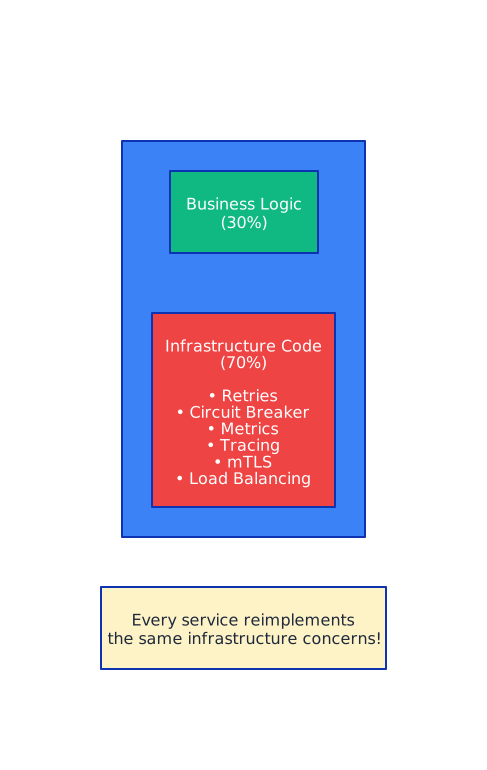
In microservices architectures without a service mesh, every service must implement infrastructure concerns: circuit breakers, retries and timeouts, load balancing, service discovery, metrics collection, distributed tracing, mutual TLS encryption, and rate limiting. This results in 30-40% of your code being infrastructure concerns, not business logic.
The problem: Teams spend significant time implementing and maintaining the same infrastructure code across multiple services. This code is error-prone, inconsistent, and takes focus away from business logic. When you need to update retry logic or add new observability features, you must update every service individually.

The solution: Service mesh moves infrastructure concerns to a dedicated layer. Your services focus entirely on business logic. The service mesh handles all infrastructure concerns consistently across all services. This separation of concerns improves code quality, reduces bugs, and enables faster feature development.

The sidecar pattern is a deployment pattern where a companion container runs alongside your main application container, providing auxiliary functionality. The sidecar shares the same network namespace and lifecycle as the main container but handles different concerns.

Service mesh architecture consists of two main components: the data plane and the control plane. Understanding this separation is crucial for understanding how service mesh works.

Key components:
Control Plane: Manages configuration, policies, and telemetry. It tells the data plane how to route traffic, what security policies to apply, and what metrics to collect. Examples: Istio Pilot, Linkerd control plane.
Data Plane: Network of sidecar proxies handling actual traffic. Each service pod has a sidecar proxy (usually Envoy) that intercepts all inbound and outbound traffic. The proxies enforce policies configured by the control plane.
Sidecar Proxy: Usually Envoy—intercepts all inbound/outbound traffic. Applications communicate with the proxy via localhost, and the proxy handles all network concerns transparently.

Several service mesh solutions exist, each with different characteristics. Understanding the options helps you choose the right one for your needs.

Characteristics:
Components:
Characteristics:
Characteristics:
| Feature | Istio | Linkerd | Consul Connect |
|---|---|---|---|
| Complexity | High | Low | Medium |
| Performance Overhead | 10-15ms | 5-10ms | 10-15ms |
| Memory Usage | High | Low | Medium |
| Platform | Kubernetes | Kubernetes | Multi-platform |
| Learning Curve | Steep | Gentle | Medium |
| Maturity | Very Mature | Mature | Mature |
| Community | Largest | Growing | Strong |
# Istio VirtualService - 80% to v1, 20% to v2apiVersion: networking.istio.io/v1alpha3kind: VirtualServicemetadata: name: payment-servicespec: hosts: - payment-service http: - route: - destination: host: payment-service subset: v1 weight: 80 - destination: host: payment-service subset: v2 weight: 20What this gives you:
apiVersion: networking.istio.io/v1alpha3kind: VirtualServicemetadata: name: order-servicespec: hosts: - order-service http: - route: - destination: host: order-service timeout: 5s retries: attempts: 3 perTryTimeout: 2s retryOn: 5xx,reset,connect-failureNo code changes needed! The sidecar proxy handles all retries automatically.
apiVersion: networking.istio.io/v1alpha3kind: DestinationRulemetadata: name: payment-service-circuit-breakerspec: host: payment-service trafficPolicy: connectionPool: tcp: maxConnections: 100 http: http1MaxPendingRequests: 50 maxRequestsPerConnection: 2 outlierDetection: consecutive5xxErrors: 5 interval: 30s baseEjectionTime: 30sTranslation:
Without Service Mesh: You need to implement mTLS in every service, managing certificates, keys, and trust stores. This is complex, error-prone, and requires expertise in cryptography.
With Service Mesh: Your application makes normal HTTP calls. The sidecar proxy handles mTLS automatically. Traffic between sidecars is encrypted, but your application code doesn’t need to know about certificates or encryption.

Service mesh handles:
apiVersion: security.istio.io/v1beta1kind: AuthorizationPolicymetadata: name: payment-service-policyspec: selector: matchLabels: app: payment-service rules: - from: - source: principals: ["cluster.local/ns/default/sa/order-service"] to: - operation: methods: ["POST"] paths: ["/process"]Translation: Only the Order Service can call the Payment Service’s /process endpoint.
Without any code changes, service mesh collects:

Without Service Mesh:
With Service Mesh:
Result: Full distributed traces without heavy instrumentation!

No need for hard-coded service URLs!
# Instead of:PAYMENT_SERVICE_URL = "http://payment-service-prod-123.us-west-2.elb.amazonaws.com:8080"
# Just use service name:response = await client.post("http://payment-service/process")
# Service mesh resolves the actual endpoint automaticallyService mesh is the Decorator Pattern applied to infrastructure!
The Decorator Pattern allows you to add functionality to objects dynamically without modifying their structure. Service mesh applies this pattern at the infrastructure level.
Service mesh applies the same pattern at the network level!

Many Microservices (10+)
Zero-Trust Security Requirements
Complex Routing Requirements
Observability is Critical
Polyglot Architecture
Small Number of Services (< 5)
Simple Architecture
Limited Kubernetes Experience
Performance is Critical
Small Team
Problem:
Solution:
Results:
Before Service Mesh:
After Adopting Istio:
Key Learning:
“We spent 6 months migrating to service mesh. The operational simplicity we gained was worth every minute.” - Airbnb Engineering
# Download Istiocurl -L https://istio.io/downloadIstio | sh -
# Install Istio on Kubernetesistioctl install --set profile=demo -y
# Enable sidecar injection for namespacekubectl label namespace default istio-injection=enabledapiVersion: apps/v1kind: Deploymentmetadata: name: payment-servicespec: replicas: 3 template: metadata: labels: app: payment-service version: v1 spec: containers: - name: payment-service image: payment-service:v1 ports: - containerPort: 8080When deployed to a namespace with Istio injection enabled:
# Canary deployment: 90% to v1, 10% to v2apiVersion: networking.istio.io/v1alpha3kind: VirtualServicemetadata: name: payment-servicespec: hosts: - payment-service http: - route: - destination: host: payment-service subset: v1 weight: 90 - destination: host: payment-service subset: v2 weight: 10apiVersion: security.istio.io/v1beta1kind: PeerAuthenticationmetadata: name: default namespace: defaultspec: mtls: mode: STRICT # All traffic must be mTLSDone! All service-to-service traffic is now encrypted.
| Scenario | Without Mesh | With Mesh | Overhead |
|---|---|---|---|
| Simple request | 5ms | 10ms | +5ms |
| With retries | 15ms | 20ms | +5ms |
| With circuit breaker | 5ms | 10ms | +5ms |
| mTLS handshake | - | 15ms | +15ms (once) |
Typical: 5-15ms added latency per service hop
| Resource | Per Sidecar |
|---|---|
| Memory | 50-100 MB |
| CPU | 0.1-0.5 cores |
For 100 services with 3 replicas each:
Infrastructure as Code
Service mesh moves infrastructure concerns from code to configuration. Focus on business logic, not retries and timeouts.
Decorator at Scale
Service mesh is the Decorator pattern applied to network infrastructure. Add functionality without modifying services.
Not a Silver Bullet
Service mesh adds complexity and overhead. Only adopt when you have enough services (10+) to justify the cost.
Observability for Free
Automatic metrics, tracing, and logging across all services without instrumentation. This alone can justify adoption.